I’ve been away for a week, which means the blog has been quiet and there is a genuinely biblical quantity of laundry currently taking over the house. The one thing keeping me cheerful through it has been the Commonwealth Games, which we went to see at Glasgow over the last six days.
The Tollcross ticketing saga alone could be its own post. We were re-seated from row H to row N by email on the way to the venue as two of our seats didn’t exist, were then issued two further sets of tickets (one occupied by someone else, one with a view that could charitably be described as “pillar-adjacent”), returned to row N and soon had a call from the ticketing manager who informed me that he was on his way to bring us new tickets in the next 5 mins, and was never seen again! I’ll spare you the full blow-by-blow. It wasn’t worth blogging about.
What was worth blogging about is what I noticed everywhere else at the venue: volunteers. Hundreds of them. Practically falling over each other in some spots, and entirely absent in others.
Presence isn’t the same as coverage
At one point, six volunteers were queuing alongside spectators for a photo with the mascot, Finnie, which meant my son (fifteen, and only doing this at all because we’d spent a week talking him into it) couldn’t get near the front. After five minutes we gave up and headed for the train. Water was the same story: we’d been told in advance to bring empty bottles, but finding anywhere to actually refill one proved close to impossible, and most volunteers seeming clueless as to the location of the taps. And when the venue emptied, the queues at the station wound back on themselves with not a soul directing where they started, finished, or turned.
No one moved when the day stopped matching the plan
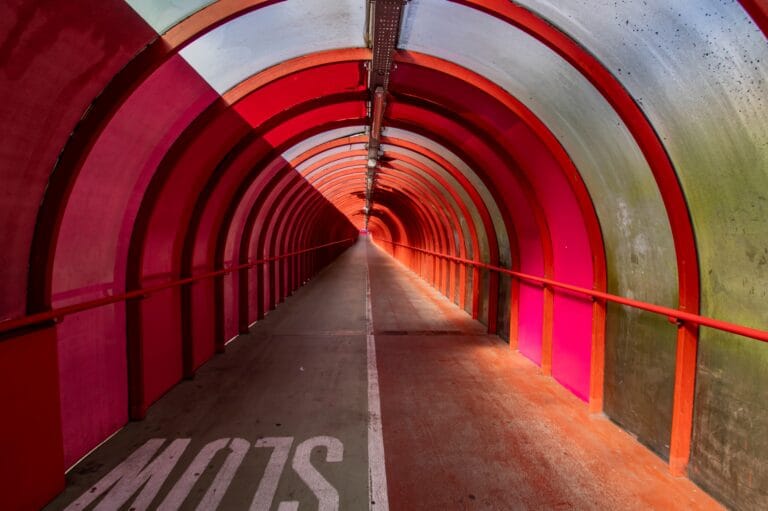
The two arena journeys that we did that week made an interesting contrast. Getting to the SEC, Hydro and Armadillo meant a covered walkway, which sounds like a small mercy until you clock that the outside of it was streaked green with slime and mould. Getting to the International Arena from Dalmarnock, by contrast, was a bare ten-minute walk with nothing along it at all, no signage, no banners, nothing to suggest you were anywhere near a Games venue.
What struck me most about both journeys was the absence of anyone lining them. At Paris, Athens, London and Birmingham, volunteers were part of the walk itself, cheering, high-fiving, stopping for selfies, turning even a dull stretch of pavement into something that felt like part of the event. Here, on two entirely different routes, there was none of that. Not one good walk and one bad one. Just nobody there, twice over.
At the International Arena itself, the entrance was closed whilst the event was running and had multiple volunteers stationed at it regardless (again, taking selfies with Finnie), while spectators streamed out of the exit at the rear of the building in their hundreds with minimal assistance for directing the flow. It’s a small thing, but it’s exactly the kind of small thing that tells you a plan was built for how the day was supposed to go, and nobody was watching for how it was actually going
It wasn’t just the volunteers
Sat next to us at the gymnastics was a group of four accredited pass-holders, lanyards and all. They were up and down like yo-yos for the whole session, and in one five-minute stretch alone I had to stand and let them past twelve times, presumably so they could take calls outside. We’d paid for our seats, timed our drinks and loo breaks around the schedule, and planned the day to see as much as possible. They came and went without a second thought. It’s a small moment, but it fits the pattern rather neatly. If the people running the event were as absorbed in watching it as everyone else, it starts to make more sense that six of them ended up queuing for a mascot photo instead of managing a queue.
The unglamorous jobs are the ones that get skipped
There’s a pattern here I recognise from client debriefs and exercise reports: the visible, front-of-house roles get covered. The mascot queue, the entrance, the places spectators can see. The unglamorous jobs, queue management, water points, wayfinding on a dark walkway, get left to sort themselves out, right up until several hundred tired people are trying to get to a train at once.
Having volunteers on a rota isn’t the same as having them where the actual pressure points are on the day. That gap between planned deployment and where people are actually needed, once reality diverges from the schedule, is precisely what a good capability review is designed to catch. It’s rarely a shortage of people that causes the problem. It’s usually a shortage of anyone watching where the plan and the day have parted company, and the willingness to move people when they have.
None of which takes anything away from what we actually saw: an English gold, two silvers and a bronze, and a Welsh gold on top. Whatever was going on with the volunteers, the athletes had absolutely no trouble finding their moment.
Anyway. Back to the laundry.